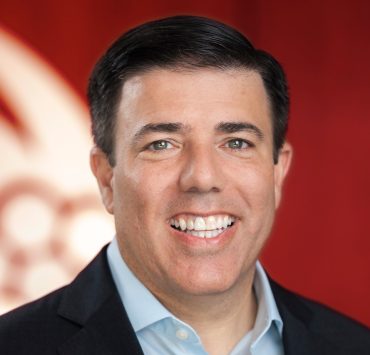
Healthcare faces a familiar squeeze: demand keeps rising while clinician shortages limit access to care. At the same time, AI is moving from experimentation into patient-facing services, raising questions for regulators and providers alike. The issue is not whether AI belongs to healthcare delivery; it is how organizations use it, govern it, and adapt as the rules keep changing.
For Beth Stevens, Chief Legal Officer at Sword Health, those questions are not theoretical. They shape the legal, regulatory, and strategic decisions her team makes every day.
Sword Health pairs AI with licensed clinicians across physical health, mental health, women’s health, and cardiometabolic care. Beth oversees legal, compliance, regulatory, governance, and public policy across multiple markets, helping leadership evaluate risk and prepare for developments where rules are not yet established.
That puts her in a position familiar to many legal leaders today. She helps a business move forward while the ground beneath it keeps shifting. “We’re really focused on delivering high-quality healthcare through AI to the world, not just US patients. We’ve expanded into Canada, the UK, Germany, and Portugal. There are many moments when AI and the clinician, working together, can help people get the care they need,” she explains.
Risk and reality
Beth treats legal risk as one input among many in a broader business conversation. “The legal risk is no different than any other risk sitting around the table. There’s product risk, financial risk, HR risk. My job is to explain the risk, explain the consequences, and I think of risk as the likelihood of occurrence times the consequence of occurrence.”
That view has followed her across transportation, lending, real estate, financial services, and now healthcare; industries with complex regulations and few easy answers. Before law, she worked in cost and risk analysis for intelligence and military clients at Booz Allen Hamilton, then earned a JD and MBA from Northwestern before realizing startups suited her better than law firms. Legal leadership roles at Sidecar, Earnest, OpenDoor, and One followed, sharpening a practical view of risk shaped by scaling businesses rather than avoiding uncertainty. “There is risk in everything you do. If you try to get a company perfectly risk-adjusted, you will not have a business. It’s not possible, particularly when you’re on the cutting edge.”
That experience also taught her to leave room for experimentation. “The law is very gray, not black or white. I like to let people run, then build in legal review at the right time. That way, you get creative solutions that benefit the consumer, follow the spirit of the law, and are easy to defend,” she reflects.
Running legal
The balance between oversight and enablement shapes how Beth leads her own team. She is convinced legal expertise alone can’t sustain a modern department. “It’s no longer the case that lawyers can just run a legal department. In fact, they’re often not great at it. I do not need to read an NDA if not a single word changes. What our legal ops team helps us do is figure out what we can automate, templatize, and let the business self-serve.”
AI has sharpened that philosophy. Beth and her colleagues tested extensively before adopting anything. “We have literally tested everything out there. Very few have made it through our gauntlet. I’m pleasantly surprised after we tried to break them,” she observes.
The team now uses AI to accelerate research, support contract review, and streamline work with outside counsel, arriving at conversations already informed. “This gives us enough tooling to get probably 90 to 95 percent of the answer, sometimes 100. Then we’re already well informed, and we’re just putting it in context with outside counsel.”
The same principle applies beyond legal. Sword is automating parts of its contract workflow across commercial, procurement, and legal teams. “It’s always easier to edit than to write from scratch. AI isn’t 100 percent perfect yet, but it still speeds us up quite a bit.”
Managing the unknown
Two connected priorities dominate Beth’s focus right now: helping her legal team keep adapting to AI, and helping Sword navigate the shifting regulatory landscape around AI-enabled healthcare.
The internal shift is as much about people as it is about technology. “This is probably one of the most transformative moments for how legal professionals work,” she says.
Externally, the uncertainty runs deeper, as regulation continues to take shape across countries, states, and markets. “We don’t know what the rules are going to be, and we don’t know what the outcomes are going to be once we have the rest of the EU AI Act and whatever the follow-on US states decide to do.”
That demands flexibility in how products are built and deployed. “You build something that works in the US today, but Illinois, Colorado, California, or New York passes something that means you can’t offer that product there anymore. We need our engineering team to build something where we can flip a switch and turn it off for people in that state.”
Behind those questions sits one Beth views as central to healthcare’s future: access to clinicians. “There are many studies showing there’s going to be a shortage of clinicians. Products like Sword make it easier to see a clinician at a time that works for you. Because it’s asynchronous and uses AI, we make the clinician more efficient so they can see more patients.” For Beth, technology and clinicians aren’t competing forces. “The promise of AI isn’t to take away the clinician’s judgment, but to supplement them so they can be more efficient and still focus on what only humans can do,” she notes.
A seat at the table
For all the attention AI commands, Beth stays just as focused on the people around the table. Success now means less about titles and more about influencing decisions and creating room for others. “I can call things out when they come to my attention, for example: wait a minute, why him but not her? It comes down to fairness and merit,” she says.
She’s especially attentive to contributions that go unnoticed. “Sometimes we all have blind spots. This is especially true for the quiet workers. I call them the grinders. Because they never complain, people never notice them. I try to be the voice that says: just because this person doesn’t complain doesn’t mean they’re not deserving.”
As Sword expands its use of AI and extends access to care, Beth will continue guiding the company through regulatory, governance, and growth challenges. But what stays with her most is personal. “To be able to influence conversations is really success for me,” she concludes.