|
Getting your Trinity Audio player ready...
|
Ian Samuel says his journey as an attorney and educator has been more akin to a chivalric romance than the “bottom-to-the-top” narrative we are all conditioned to believe is the “correct” path. While he’s joking, he has a point. Samuel’s résumé is not a ladder—it’s a series of chapters that seem to run their own course at precisely the right time another begins.
The current senior assistant general counsel at Altria never imagined he’d be providing strategic guidance and support for a nicotine products company. But in his role, Samuel gets to play a leading role in bringing smoke-free products to market, which can potentially cause much less harm than the traditional cigarettes.
“We want to transition people to FDA-authorized, lower-harm products,” Samuel says simply. “The right way to do that, we believe, is not just to prohibit a whole class of products, but, instead, provide alternatives adult consumers want. We have a variety of those in our portfolio, so I get to see that transformation in real time.”
Altria is only Samuel’s latest chapter. Those that have come before are equally as engaging, puzzling, and most importantly, page-turning.
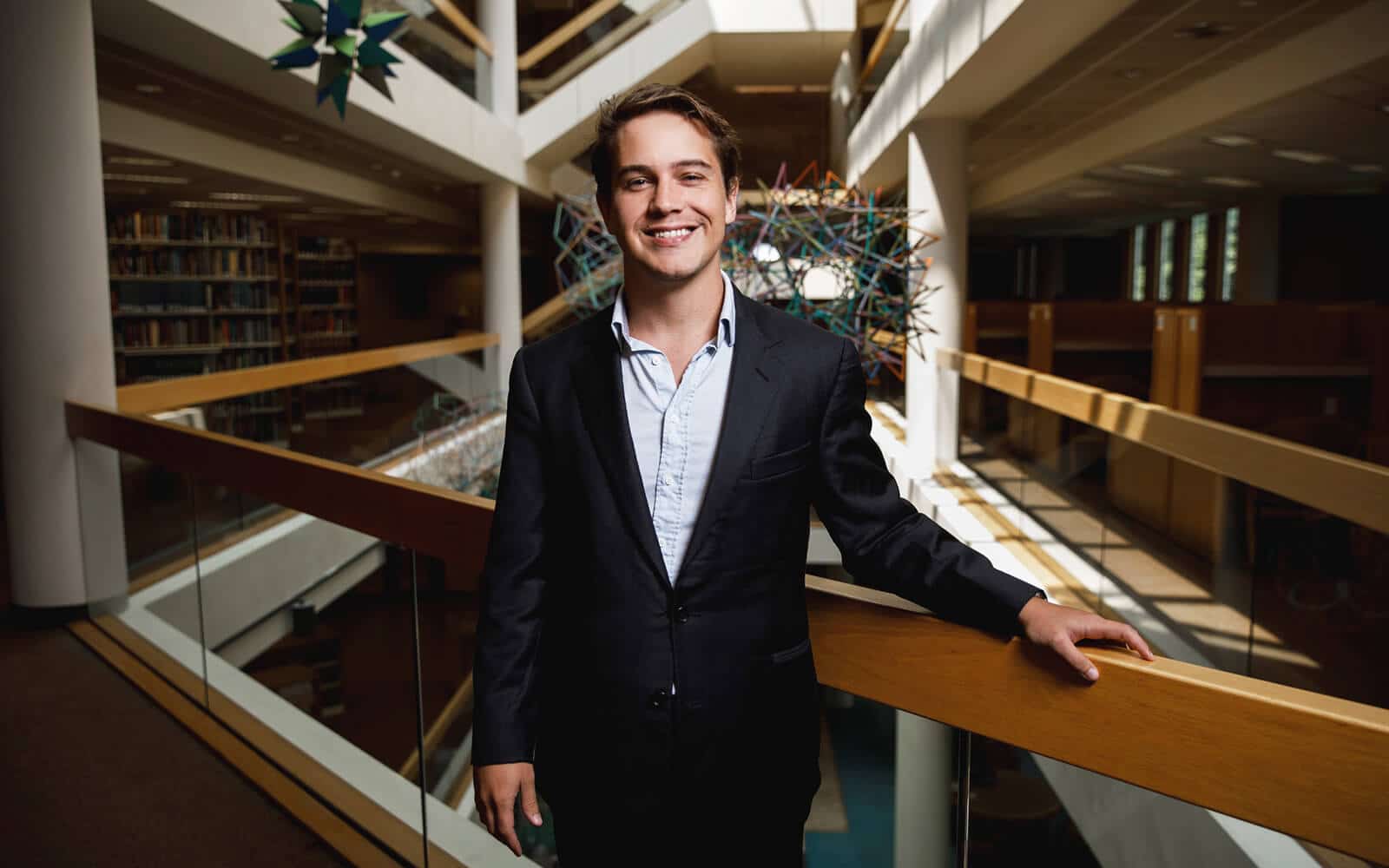
The future lawyer earned his undergrad in computer science. Samuel has a way of speaking that puts him well at home among those in the tech industry, at least those we have come to know in the public arena. When Samuel speaks, he doesn’t waste words, nor does he seem to struggle to find the right ones. He speaks precisely, diligently, and while the thoughts are coming off the top of his head, they feel measured and weighed, thoughtful and contained.
Samuel had been a college debater. Seeing his friends go to law school, he took the LSAT as well. Computer-scientist-turned-patent-attorney seemed to be an established path, so he decided to pursue it.
“I think law school was the first time I actually enjoyed being in school,” the AGC says. “I think that is unusual. You often hear about how much people hated law school, but it’s where my horizons broadened substantially. My aperture widened.”
The lawyer would clerk for the United States Ninth Circuit Court of Appeals under the Honorable Alex Kozinski, a judge well known for driving his clerks hard. The judge would get to work around 9:30 and continue to work, either in his chambers or at home, until 1:00 or 2:00 in the morning. The clerks would take turns getting dinner and going for breaks, working seven days a week, and any other time the judge needed them.
“Whenever I’m letting go of a draft, I always have this voice in me asking me if I should read it one more time before I hit Send,” Samuel says. “That’s Judge Kozinski. Working for him was a formative experience.”
From there, Samuel spent three years at the US Department of Justice, first as a Bristow Fellow and then as appellate staff in the Civil Division. During that time, Samuel was trying to find his way to clerking on the Supreme Court, a near statistical impossibility. Except it wasn’t. The lawyer was brought in to interview in the office of Supreme Court Justice Antonin Scalia. He prepped for the interview for two weeks.
“I may not have known a lot, but I knew enough to know the interview was going to be very in-depth and very substantive. I read all of his major opinions.”
Samuel got the clerkship and was soon sitting first row for arguments on landmark cases of the 2010s, including the Federal Defense of Marriage Act and the California Proposition 8 same-sex marriage ban.
“You often hear about how much people hated law school, but it’s where my horizons broadened substantially. My aperture widened.”
Ian Samuel
These are the episodes, the seasons, and the experiences. After going to firm Jones Day, Samuel would earn a Climenko Fellowship at Harvard, where he would also lecture and teach. He’d go on to teach cybersecurity and civil procedure at Indiana University. This was the “Academic Chapter.”
Then there was the call of longtime friend Paul Cappuccio and former general counsel at Time Warner, asking if he had any interest in going in-house at a company working to “make smoking history.”
The vaping company NJOY would be so successful that it would be acquired by Altria in 2024. In a rare move, Samuel was asked to come with the company.
And today, Samuel is still in his “In-House Chapter,” having moved to the suburbs of Southern California, a city boy learning to live life a little differently.
The focus on his journey here is intentional. It’s not typical. It may not even be recommended. But it is interesting.
“Life isn’t like the résumé we all learn how to write,” Samuel says. “I’ve tried to allow myself to be open to logical beginnings and endings. Real life is not moving from one successful thing to the next in this logical sequence. If you don’t make yourself open to possibilities, I think life could be very boring.”
Before It Was Cool
In 2016, when podcasts were seeing a surge in popularity, there were still untouched topics left to cover. That’s when Ian Samuel created First Mondays, the first podcast about the happenings on the Supreme Court.
The show, which attracted listeners from the legal community and major news organizations, became influential enough to inspire copycat podcasts in the years that followed, but at the time, Samuel was just trying to fill a gap.
“I thought it would be fun to listen to a podcast that covered the Supreme Court like sports,” Samuel says. “I couldn’t find one, so a friend and I created one.”