|
Getting your Trinity Audio player ready...
|
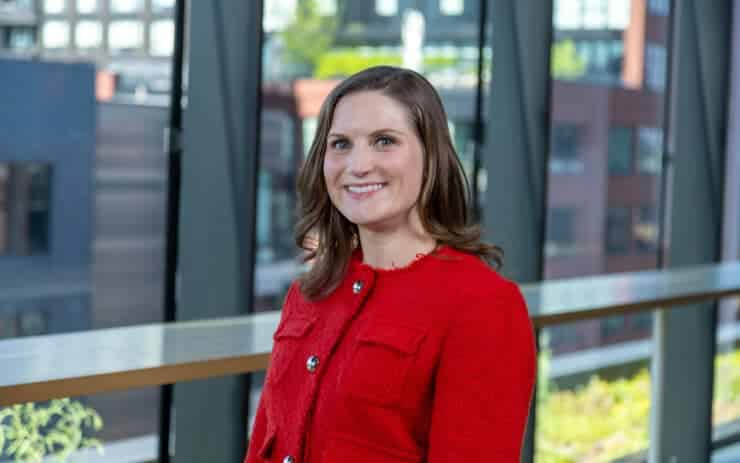
College coaching legend John Wooden is attributed to just about any motivational quote that isn’t already connected to Yogi Berra. But in this case, it’s all the more fitting. “The best players don’t win championships. The best team players win championships.” Whether or not Wooden said it isn’t of great concern here, because it’s about the bigger picture, the team at large. That’s the philosophy that has guided Elizabeth “Libby” Wassef’s entire legal journey.
The managing counsel and head of workplace investigations at McDonald’s played softball—center field—to be exact, at Yale during undergrad. She says that athletics, the experience of being on a team and contributing to a larger goal, stuck with her long after her last at-bat. It’s probably why during the course of her interview with MC, the attorney seemed to shift every focus away from herself, the individual, to her team at McDonald’s. Wassef wins as a team; it’s the reason she went in-house nearly twelve years ago in the first place.
“One of the things I enjoy most about being at McDonald’s, as opposed to a firm, is that the culture here is very much that of one team,” Wassef explains. “My team knows that I genuinely value their feedback, and I think they also know that I spend a lot of time doing my best to bring out their best, whatever those individual strengths may be.”
Wassef’s group includes lawyers, HR professionals, security experts, and career investigators. It’s a blend of personalities and skill sets she celebrates for its synergy. In meetings, her team takes time to recognize individual and group accomplishments, large and small. Shoutouts are plentiful, and now are international, as her leadership now includes Canadian and Australian counterparts.
When thinking back to her early days at McDonald’s, Wassef invokes the advice of managing counsel for labor and employment law, Rafael Medina, one of Wassef’s earliest mentors.
“Rafael, who has been a mentor to so many here, told me that coming in-house was a communications job, and that’s how I should approach it,” Wassef recalls. “I remember a friend telling me that working at a law firm is like doing homework for a living—it’s very isolated and research-based. Being in-house is not like that at all. It’s about translating advice, writing clearly and concisely, and communicating with stakeholders and clients.”
That communication is even more important given McDonald’s culture, one that Wassef considers relationship based. The managing counsel says part of the reason she has stayed with her organization so long is because of the kindness, humility, and collaboration she sees at every level of her business. In fact, Wassef has seen difficult personalities attempt leadership positions at McDonald’s, less humble and more aggressive.
“They don’t last long,” Wassef says.
Wassef has continued to accumulate more responsibility across her organization. In her first management role, the counsel oversaw two paralegals. With recently announced expansion plans for her team—the result of substantive success for the more formally entrenched investigations team—she will see upwards of thirty people reporting to her in just a few short years.
Those increased responsibilities come on the heels of what Wassef says is excellent work by her team to build consistency in how the company conducts internal investigations.
“Across the US, we saw a lack of consistency and a lack of data in some cases, and as we’ve worked to solve that, we’re working to implement that across more geographies,” the managing counsel explains. “Different parts of the world are different, obviously, but there are lessons learned that we can tweak and implement to ensure a One-McDonald’s strategy we’ve been working toward.”
Just a day before her interview, Wassef found out that Germany, France, the UK, and Ireland would also be falling under her remit. Eventually, so will India and Mexico.
“My team is growing exponentially, which is exciting,” Wassef says. “I think it’s an incredible example of the culture of care here. In our business, things can’t always be perfect. But when we mess up, we do the right thing. I’ve seen it here again and again. People care about what they’re doing, and they genuinely want to do the right thing.”
Ron Machen and Brenda Lee, partners at WilmerHale, add, “Libby combines deep legal expertise with a practical approach to risk management. Her guidance helps McDonald’s stay agile in a fast-changing business environment.”
The work can be tough at times. No workplace investigation happens because things are just ideal. Wassef says the hardest burden of her team falls on those working closer to the front lines. Her role is to support them and provide an outlet when they need someone to talk to.
But what matters most, Wassef says, is that she can’t remember a single moment when something went wrong and leadership disagreed about doing the right thing. Even on the hardest days, the team is aligned from the top down and bottom up.
Wassef’s team is growing, and she seems genuinely pleased to have the opportunity to bring more people to McDonald’s. Not because it will make her life easier, but because she knows the value they can find in being part of a culture of care.